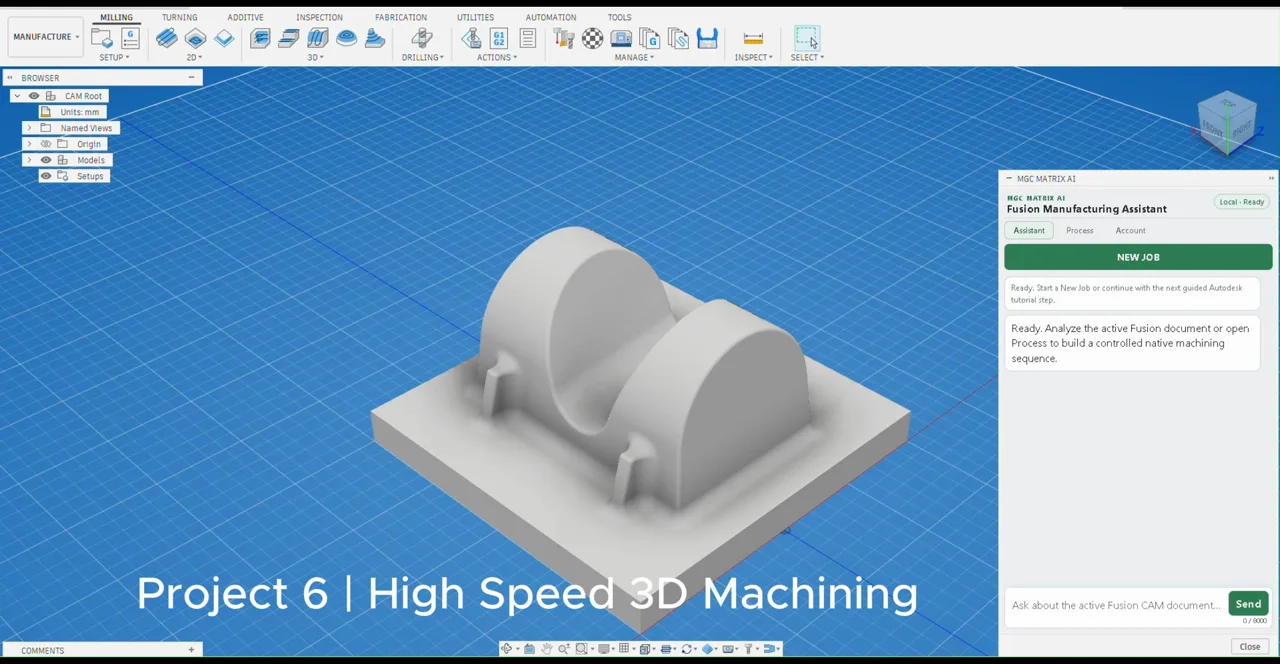
3D cavities, walls and fillets need far more machining decisions than a flat 2.5D plate: roughing, rest machining, flat areas, wall finishing, surface finishing and pencil passes into tight corners. Projects 6 and 7 show MGC Matrix AI building those sequences as native Autodesk Fusion CAM operations — and stopping for a simulation review before anything reaches the machine.
Project 6 — high-speed 3D machining
Starting from the active Fusion model, MGC Matrix AI creates the milling setup, checks the part for CAM readiness and builds a high-speed 3D sequence. In the recorded run all 8 operations are created with valid native toolpaths, then the engineer opens the full Fusion simulation to review material removal.
Project 7 — advanced 3D machining
The second part is a deeper double-cavity component. From the DFM review MGC proposes a 10-operation plan, approved once and then built and verified operation by operation inside Fusion:
- Face top
- 2D contour — outside
- 3D adaptive rough — cavity
- Adaptive rest machining
- Horizontal — flat areas
- Contour — cavity walls
- Parallel finishing
- Pencil Ø3
- Pencil Ø2
- Pencil Ø1
The plan comes from a deterministic planner — no AI call, no tokens — and Fusion itself calculates every toolpath. All 10 operations finish with valid toolpaths before the simulation step.
Simulation first, then the production package
NC output stays locked until the engineer has reviewed the complete Fusion simulation and confirmed it. Only then does MGC generate the production package: NC programs from the chosen Fusion post processor, setup sheets and PDF documentation.
As with any CAM system, post-processor configuration, cutter data, workholding and an on-machine prove-out remain the engineer's responsibility.
See it on your own parts
Projects 5, 6 and 7 move MGC Matrix AI from 2.5D plates to real 3D surface work. If your team spends hours building repeat CAM sequences in Fusion, MGC can run a technical evaluation on representative parts from your shop.
Discuss a relevant engineering requirement: request a technical demonstration or quotation.